COVID-19 and contracts: a “Safe Harbor” period of time

With the lockdown harming the economy, the French Government enacted special measures to provide both flexibility and protection regarding contractual and administrative deadlines. Order No. 2020-306 dated 25 March 2020 on “the extension of time limits during the state of health emergency and the adaptation of procedures during the same period” created a “Safe Harbor” time period during which contractual deadlines and associated sanctions are suspended or postponed.

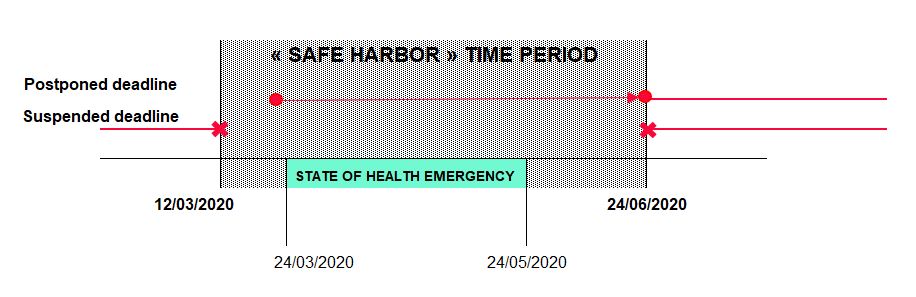
The “Safe Harbor” time period at a glance: from 12 March 2020 to 24 June 2020
Contract performance difficulties

Contracts usually contain penalty, termination or default clauses intended at protecting one party if the other party fails to perform its obligations within the contractually agreed time limits (e.g. delivery, payment, maturity).

(i) If this contractual time limit ends during the “Safe Harbor” time period, i.e. between 12 March and 24 June 2020, these clauses shall be deemed to not have taken effect.

These clauses will only take effect one month after the end of the “Safe Harbor” time period only, i.e. as from 25 July 2020, provided that the debtor has not performed its obligation in the meantime.

Example: In compliance with the termination clause of your contract, you gave your contractual partner formal notice to fulfil its obligation within 10 days from 6 March 2020. The deadline ends during the “Safe Harbor” time period, i.e. on 16 March 2020. This 10-day deadline will resume as from 25 July 2020 and will therefore end on 3 August 2020.

(ii) If the enforcement of a penalty clause – or the penalty payment – took effect before 12 March 2020, i.e. before the starting date of the “Safe Harbor” time period, it shall be suspended during that period. The countdown will then resume as from 25 June 2020.

Example: A contract provides for a daily penalty if the contractor does not perform its obligation by 27 February 2020 at the latest. On 28 February 2020, the creditor gave formal notice to his contractual partner to fulfil its obligation within 10 days. On 9 March 2020, the penalty payments start to apply. However, as from 12 March 2020, these periodic payments are suspended and will resume as from 25 June 2020 only, if the contractor has not performed its obligation in the meantime.

It is therefore necessary to systematically check:

– If the deadline to fulfil the obligation ends during the “Safe Harbor” time period, in which case its starting point is postponed until one month after the end of that period (i.e. on 25 July 2020), if the contractor has not performed its obligation by that time.

– If the penalty clause or the periodic penalty payments took effect before 12 March 2020, which implies the suspension of the penalty until the end of the “Safe Harbor” time period (i.e. 25 June 2020).

Termination or automatic renewal of contracts

If the deadline to terminate the contract or to give notice (to avoid its automatic renewal) ends during the “Safe Harbor” time period, this deadline is extended two months after the end of that period, i.e. until 24 August 2020.

Example: If you were not able to terminate a contract that is automatically renewed every 31 March, unless giving termination notice during the month before the “anniversary date”, it will still be possible to terminate it until 24 August 2020.

Relationship with the French administration

Suspensions and postponements also apply to relationships with French central, regional and local administrations, public entities and bodies governed by public law (or by private law when they are in charge of public services), including social security bodies.

Decision, approval or ruling to be issued by the administration

If the time period during which a decision, an approval or a ruling from the administration shall/may occur or is deemed to have been taken, ends during the “Safe Harbor” time period, this deadline shall be suspended until the end of the “Safe Harbor” time period, i.e. until 24 June 2020.

If the countdown started to run before 12 March 2020, it shall be suspended until 24 June 2020. The countdown will start again as from 25 June 2020.

If the countdown started to run after 12 March 2020, its starting point is postponed until the end of that period: it will start again as from 25 June 2020.

Example: In case of foreign investments subject to prior authorization from the French Minister of the Economy, the authorization cannot be deemed to have been granted, in case of absence of reply within two months, if this period did not expire before 12 March 2020. Otherwise, the period is suspended and will run again as from 25 June 2020.

Verification of the completeness of a file, request for additional information for the examination of a request, public consultation or participation requested by the administration.

See the previous paragraph. The deadline is suspended or postponed, according to its expiry date or its starting point. This applies, for example, in case of an investigation by the administration.

You should also consult the web site of the concerned administration to find out how it operates during the lockdown (French Anti-Corruption Agency, Competition Authority, Dual-Use Goods Control Office, etc.).

Performance of inspections and work by companies or bringing companies into compliance with requirements

The above rule also applies:

– If the deadline laid down by the administration did not expire before 12 March 2020 (except where the deadline is issued by a Court), that deadline is suspended until the end of the “Safe Harbor” time period (i.e. 24 June 2020).

– If the deadline started during the “Safe Harbor” time period, its starting point is reported until the end of that period.

Example: In case of an order issued on 12 March 2020 by the General Directorate for Competition Policy, Consumer Affairs and Fraud Control (DGCCRF) to comply with a regulation, the deadline for compliance will only run as from 25 June 2020

For categories of decisions, procedures and obligations for which it is not appropriate to suspend time limits, for reasons of protection of the fundamental interests of the Nation, security, protection of health, public sanitation, decrees specify the applicable rules.

Examples: Operators of installations classified for the protection of the environment (ICPE), water structures (dikes, dams), mining installations, pipelines for transportation of hazardous materials, etc. (Decree No 2020-383 of 1 April 2020 derogating from the principle of suspension of deadlines during the period of health emergency related to the covid-19 epidemic).

Alerion’s Commercial Law and Compliance & Regulatory teams are at your disposal to assist you to review your case:

Catherine Robin, Frédéric Saffroy, Partners, Justine Clerc and Jeanne Quéneudec, Associates.

Coronavirus and commercial contracts

Since January 2020, the COVID-19 spread around the world, killing thousands of people and affecting massively business and trade.

This crisis has a major impact on global economy, as many affected countries issued strict lockdown measures for several weeks.

As with previous epidemics, the question will arise whether or not the criteria of Force Majeure are met for contracts subject to French law.

Under French contract law, the legal regime of Force Majeure is a default rule governed by the Civil Code and case law. Moreover, the contracting parties may adjust or exclude it.

The criteria of Force Majeure under French law

The COVID-19 and the issues it generates (illness, lockdown, administrative police measures, etc.) cannot be automatically considered as Force Majeure.

Article 1218 of the French Civil Code defines Force Majeure as “an event beyond the control of the debtor, which could not reasonably have been foreseen at the time of the conclusion of the contract and whose effects could not be avoided by appropriate measures, prevents performance of his obligation by the debtor.”

Thus, an event may be considered as Force Majeure if the following three criteria are met:

• The event is beyond the control of the debtor (external criterion);

• The event could not reasonably be foreseen at the time of the conclusion of the contract (unforeseeable criterion). Parties who have recently entered into a contract may face difficulties to claim force majeure because of this criterion;

• The effects of the event could not be avoided by appropriate measures (irresistible criterion). For instance, the search for a new service provider, or a new supplier.

Case law on epidemics in France

A review of French case law shows that Courts generally refuse to consider epidemics as Force Majeure.

In the past, Courts considered that:

• The epidemic of Dengue fever was recurrent and therefore predictable (Court of appeal of Nancy, 22 November 2010, RG nº 09/00003) ;

• The Ebola virus made the performance of contractual obligations more complex and difficult, but not impossible (Court of appeal of Paris, 29 March 2016, RG nº 15/05607) ;

• The Chikungunya virus was not irresistible since it was generally curable (Court of appeal of Basse-Terre,17 December 2018– n° 17/00739).

However, the current situation may be considered as different from previous crisis, because it affects all countries and international trade, in addition to which large-scale lockdown measures have been enforced by several Governments, including the French one.

It is worth noting that if the introductory report to the Order dated March 25, 2020 (Order n° 2020-306 of March 25, 2020 on the extension of time limits during the period of public health emergency and the adaptation of procedures during the same period) states that “Payment of contractual obligations must still be done on the date stipulated in the contract”, the Order also specifies that ordinary law provisions such as Force Majeure “remain applicable where appropriate if their conditions are met”.

In any case, Courts will decide on a case-by-case basis if the debtor has been unable to perform his contractual obligations due to the COVID-19 and its consequences.

The consequencesof force majeure

If the criteria of Force Majeure are met, Article 1218 of the French Civil Code offers two options:

• If the Force Majeure event is temporary, performance of the obligation is suspended for the duration of that event, unless if that delay justifies termination of the contract.

• If the Force Majeure event is permanent, the contract is terminated by operation of law and the parties are discharged from their obligations. In that case, difficulties may arise if the contract was already partially performed (for example, the supplier incurred costs or the customer has made a down payment).

Parties to a contract may exclude or adjust the effects of Force Majeure on their contractual relationships.

One has to examine in detail, whether and to which extent a particular contractual obligation is concerned and its fulfillment impeded. There may be options to be considered, which could mitigate the impacts on the contract.

We therefore advise:

• To check if the contract includes a Force Majeure clause or excludes such a mechanism. If nothing is mentioned, the legal mechanism of the Civil Code is applicable;

• To check if the legal or contractual criteria are met;

• To identify if the contractual Force Majeure clause includes a mandatory formality that shall be complied with in order to enforce it.

The Hardship mechanism

Even if the Force Majeure mechanism cannot be applied to every cases, the French Civil Code provides a right to renegotiate the contract in case of change of circumstances (the equivalent of a legal hardship provision).

In order to benefit from this mechanism, it must be evidenced that a change of circumstances – that was unforeseeable at the time of the conclusion of the contract – makes the performance of the contract excessively onerous for a party who had not accepted the risk of such a change.

In accordance with Article 1195 of the French Civil Code, that party may request the other party to renegotiate the contract.

In the meantime, that first party shall continue to perform his obligations during renegotiation.

Again, contractors may adjust or exclude this mechanism in the contract. The opt-out clause may concern all contractors or only one of them.

The new mechanisms introduced by the Order of March 25, 2020

On March 25, 2020, the French government issued an Order to protect debtors from the consequences of an unfulfilled contractual obligation.

Article 4 of that Order limits the creditor’s use of several contractual mechanisms (periodic penalties payments, penalty clauses, termination clauses) where they sanction the breach of an obligation that should have been met between March 12, and June 24, 2020 (the date of June 24, 2020 may be postponed if the duration of the health emergency measures is extended in France).

These contractual mechanisms will resume, and be enforceable again, one month after the end of the above period of time if the debtor did not performed his obligation within that time limit.

Article 4 also mentions that periodic penalty payments and penalty clauses which were enforced before March 12, 2020, are suspended between that date and June 24, 2020.

In case of difficulties to meet contractual obligations, we advise analyzing which legal or contractual mechanism (Force Majeure clause, Hardship clause or application of Order dated March 25, 2020) is the most appropriate.

Jacques Bouyssou, Partner and Karadeg Coeffic, Associate in the Litigation, Arbitration and White-collar crime department.

Frédéric Saffroy, Partner in the Commercial Law department.

COVID-19: homeworking and cybersecurity

Following the lockdown measures adopted by the French Government as of 17 March 2020 at 12:00 Paris time, homeworking is the ultimate solution for many companies.

This forced distant working obliges companies to request from their employees a cautious and careful implementation of measures aiming at protecting processed data. Whatever this data is (commercial, financial, technical, legal, administrative, etc.), it is essential to the continuation of your business and the sustainability of your company.

Cyber-attacks (ransomware, phishing, fake president fraud, identity theft, etc.) will not cease during the COVID-19 crisis, and the risks are enhanced by the dispersion of homeworking employees. An IT crisis should not be added to the health crisis.

Below are recommendations based on the assumption that your employees are working from home (these would be stricter if working from a coworking space, a hotel or even in transportation, but this should not be the case with lockdowns):

• Avoid as much as possible the use of devices that are not provided by the company (BYOD): The company cannot monitor, control and secure them as much as its own ones.

• Ensure constant watchfulness on the devices provided by the company, as private residences do not provide the physical protection offered by the company premises: Switch off the laptop and store it discreetly when you leave home; Do not leave the laptop alone in a vehicle, even locked; Do not leave the laptop alone in a place visible from the outside.

• Connect to the company resources only via VPN or via a secured cloud.

• Check that the Wi-Fi used at home is secured and requires a strong password to connect.

• Do not forward your professional emails on your private/personal mailbox.

• Do not plug/connect (physically or via Wi-Fi or Bluetooth) personal devices or third party devices (such as USB keys, SD cards, external hard drives, connected devices, etc.) to the professional laptop of the company.

• Do not allow other family members (even less third parties), including children, to use the laptop.

• Pay attention to any sensitive call or videoconference you may have. Professional discretion still applies.

• Finally, alert your IT manager and your DPO (data protection officer), as well as your security officer (if the company has one) in case of any security incident.

Your vigilance and that of your employees are essential to the integrity of your systems, to the protection of your information and to the sustainability of your business.

For any question, please contact Alerion’s lawyers, and more particularly: Frédéric Saffroy and Corinne Thiérache.

Employment law and digital platforms

Even if no specific regulations exist for the digital platforms, the issues raised by the new ways of working in the “gig economy” can explain a couple of recent decisions delivered by the French Supreme Court.

Indeed, the Cour of cassation’s decision of March 4th 2020 confirmed that when the driver connect to the UBER digital platform, a relationship of subordination between him and the Company was established.

Consequently, the lack of independence and the existence of a relationship of subordination could indicate the fictive nature of the independent worker status.

The criteria taken into account by the judge were as expected:

– The driver worked for an organized transport service under terms defined unilaterally by UBER as a result, the driver was unable to:

· Organize his own professional activity,

· Set his own fares, which were set by UBER’s algorithm,

· Choose his own route without receiving a price correction form UBER,

· Choose freely a ride proposed by UBER, the final destination not necessarily being known by him in advance,

· Build up his own customers,

· Choose his own suppliers.

– The exercise of, indirect or disguised, disciplinary power through:

(i) UBER is temporarily disconnecting drivers after three ride refusals;

(ii) the application of fare adjustments if the driver chooses an “inefficient route” different to UBER’s recommended route;

(iii) the deletion of the driver’s account in the event of non-compliance with the cancellation rate set unilaterally by UBER or “problematic behaviour” reported by users.

From UBER’s side, the driver “remains entirely free to connect to the application or not, to choose the location and the time he/she intends to connect, without informing the platform in advance, and to put an end to the connection at any moment”; this argument has been rejected by the judge.

Impacts of the decision

In spite of this decision, the digital platform business model, from the sharing economy, should not be really challenged for the moment, although further thinking is probably required about its practical implementation.

Indeed, the call into question of the business model will mainly depend on the number of disputes before the courts, which are few to date.

But UBER should not avoid the financial consequences of this decision; reclassification of the employment contract could effectively lead to the payment of social contributions.

Jacques Perotto, partner, and Quentin Kéraval, associate, in Alerion’s Employment department

Thomas Cook : the end of the journey

On November 28th, 2019 the Commercial Court of Nanterre, France, selected the offer of 11 travel compagnies to buy-off 149 Thomas Cook agencies (out of a total of 174 in France). One employee out of two will be saved; it is now time for the bankrupt Group to manage the suppression of 338 positions in France and consult its staff representatives.


Thomas Cook employs 685 people in France with a €750K turnover.

On the September 23rd 2019, Thomas Cook announced it was entering a compulsory liquidation process in France ; no global offer was made and so far only 149 Thomas Cook and Aquatur Agencies have been taken over by 11 different travel Groups and compagnies (such as Havas Voyages, Karavel-Promovacances etc).

Thomas Cook will be dismantled and only 347 positions will eventually be safeguarded.

The Central Works Council will soon be consulted on the social plan and the projected redundancies.

Indeed, according to the French Labor Code, an information/consultation procedure with the Works Council (“CSE”) or the Central Works Council (“CCSE”) needs to be implemented; two official meetings should be organized by the Employer with three objectives in order to:

– Reduce the effects of the downsizing reorganisation on the employees

– Reduce the number of people supposed to be made redundant

– Find re-employment solutions for all employees affected by job cuts

A specific document drafted by the employer or negotiated with the unions must be sent to the French Labor Authorities for approval.

However, in the case of compulsory liquidation, the constraints on the employer are considerably reduced as there’s only one “CSE” (or “CCSE”) meeting and the social and financial measures implemented by the employer need to be mitigated. The approval, supposed to be given by the French Labor Authorities, is by consequence easier to obtain.

Moreover, the French Labor Regulations provide that the compulsory liquidation is, in itself, a fair ground for lay-offs ; meaning that the Employer is not obliged to justify his decision with economic and financial explanations. By consequence, the dismissal decision taken by the employer is rarely challenged in Court, unless it is a case of manifest fraud ; this would be the case if, for example, the parent company took over all the assets from its subsidiary for its own benefit.

Finally, in the event of non-compliance of the mandatory information/consultation procedure with the Works Council “CSE” or “CCSE”, the Company would be sentenced to pay a €3,750 fine.

In the case of Thomas Cook however, it is already planned to consult the staff representatives of the Group on a social plan and potential redundancies of the employees that were not concerned by the buy-back offers.

Despite Thomas Cook’s bankruptcy, the employees that will be made redundant will not entirely be left by the wayside since they will benefit from the “AGS” insurance which, in France, guarantees the payment of salaries in case of liquidation.


Jacques Perotto, partner, and Arielle Duchène, associate, in Alerion’s Employment department

Lexpress Compliance – Foreign Investments – New French regulation

Alerion has published a new issue of “LexPress” dedicated to French regulation on Foreign Investments.

Since January 1st, 2019, the scope of controlled activities became broader, with new sectors requiring prior authorization from the French Government, such as R&D activities in the fields of cybersecurity, AI, robotics, or 3D manufacturing. In addition, the future so-called “PACTE Law” – currently under review at the French Parliament – will shortly provide the Ministry for Economy with extended powers and graduated responses to enforce Foreign Investments regulation, and ensure its efficiency. Firms that intend to invest in French innovative businesses should consider whether they fall within the scope of this new regulation.

Lexpress Compliance : Dual-use goods, a new guide for Internal Compliance Program

Alerion has published a new issue of “LexPress” dedicated to dual-use goods and compliance programs to be implemented by exporters.

With innovation, dual-use goods – civilian and military – are hidden everywhere : special metals, nanotechnologies, ball bearings, calculators, electronic components, sensors, software, GPS, radios, etc. The latest concerns of the authorities are with drones and cryptology (present in many communication applications).
Therefore, it is essential that you ask yourself whether your activity, products and/or services fall within the scope of dual-use goods export control regulations.

Summary of our privacy policy

This version was uploaded January 2020

As data controller, Alerion is strongly committed to protecting your personal data (hereinafter referred to as "Personal Data" or "Data"), as defined by the General Data Protection Regulation (EU) 2016/679 and by the amended French Act No. 78-17 of 6 January 1978 on Information Technology, Data Files and Civil Liberties (hereinafter collectively referred to as "Regulations").

This Privacy Policy transparently outlines the manner in which Alerion collects, stores, uses and discloses your Personal Data when you visit the Website, accessible on https://alerionavocats.eliott-markus.cloud/ (the "Website") and/or when you request services or information offered on the Website (in the “Services" section).

When appropriate, this Policy is supplemented by our General Terms and Conditions of Services, which are attached to Alerion's engagement letter, as well as by the required information provided in our Data Collection Forms.

By using the Website, you accept this Privacy Policy.

More information here

This site is registered on wpml.org as a development site. Switch to a production site key to remove this banner.